Screen Time for Kids: Learning vs Scrolling Impact Explained

Screen Time for Kids: Learning vs Scrolling Impact Explained

Introduction

Today, children use screens every day. They watch videos, play games, and attend online classes. But an important question is: are they learning or just scrolling?
Screen time for kids means the amount of time children spend on phones, tablets, computers, or TV. Not all screen time is bad. Some of it helps in learning. But too much screen time for kids can affect their focus and growth.
Parents and teachers must understand the difference between useful and harmful screen time for kids. This helps children use technology in a better way. 

1. Core Concept of Screen Time for Kids

Screen time for kids is not just about time. It is about how the screen is used.
There are two main types:

● Active screen time – learning apps, educational videos
● Passive screen time – endless scrolling, random videos

Active use supports learning. Passive use mostly wastes time. 

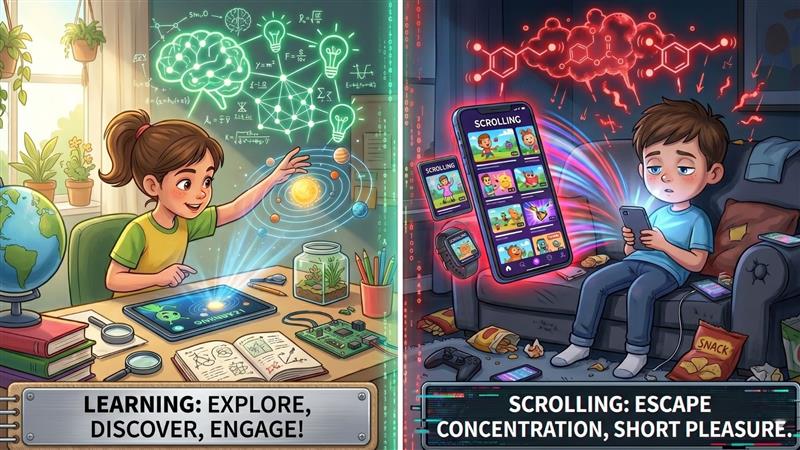
2. Learning vs Scrolling: Key Difference

There is a clear difference between learning and scrolling.

Learning:

● Has a clear goal
● Improves knowledge
● Requires thinking

Scrolling: 

● No clear purpose
● Short attention span
● Mostly entertainment
When screen time for kids is not planned, it becomes scrolling instead of learning. 

3. Scientific / Logical Reason

The brain reacts differently to learning and scrolling.
● Learning builds strong brain connections
● Scrolling gives quick pleasure but no deep thinking
● Fast content reduces attention span
Too much screen time for kids can make it harder for them to focus on studies. 

4. External Factor (Environment, Habits, etc.)

The environment plays a big role.
Important factors:
● No screen rules at home
● Easy access to mobile devices
● Parents using phones all the time
If children see adults always on screens, they copy the same habit. Balanced routines help manage screen time for kids

5. Psychological Factor (Interest, Motivation, etc.)

Children use screens more when:
● They feel bored
● They lack interest in studies
● They get instant rewards from videos
Scrolling gives quick happiness. Learning needs effort. So children often choose scrolling over learning during screen time for kids

6. Emotional Factor (Confidence, Fear, etc.)

Too much screen use affects emotions.
Possible effects:
● Low confidence
● Irritation when screen is removed
● Fear of missing out (FOMO)
Balanced screen time for kids helps maintain emotional stability. 

7. Skill/Practice Factor

Skills grow with practice, not scrolling.
Excessive screen use can reduce:
● Reading skills
● Writing ability
● Communication skills
Children need offline activities like:
● Playing outside
● Reading books
● Talking with others
Controlled screen time for kids supports better skill development. 

8. What Science Says

● Too much screen use reduces attention span
● Blue light affects sleep quality
● Fast content impacts memory
● Educational content improves learning when limited
● Screen breaks improve brain function

Key Takeaway

● Not all screen time is bad
● Learning-based screen use is helpful
● Scrolling wastes time and reduces focus
● Balance is very important
● Parents should set screen rules
● Limit screen time for kids daily


Frequently Asked Questions (FAQ)

Q1. How much screen time is safe for kids?
1–2 hours of quality screen time per day is generally safe.
Q2. Is all screen time harmful?
No. Educational content is useful if used in limits.
Q3. How to reduce screen time for kids?
Set rules, encourage outdoor play, and limit device access.
Q4. Can screen time affect studies?
Yes. Too much screen use reduces focus and concentration.